How to Fix a Printer That Won’t Install: Complete Setup and Troubleshooting Guide
Introduction
Installing a printer should normally be straightforward, but sometimes the installation process fails before the printer is ready to use. You may see messages such as “Printer installation failed,” “Driver unavailable,” “Unable to install printer,” or “Windows could not connect to the printer.” The problem can occur with USB, wireless, or network printers and may prevent your computer from detecting or communicating with the device.
Printer installation failures can have several causes, including incompatible drivers, connection problems, outdated operating systems, insufficient permissions, conflicting printer software, security software, or problems with the Windows Print Spooler service. The source article also highlights driver compatibility, connectivity, system conflicts, permissions, and previously installed software as common causes.
Fortunately, most installation problems can be resolved without replacing the printer. This guide explains practical ways to troubleshoot a failed printer installation and establish a reliable connection.
Why Does Printer Installation Fail?
Understanding the possible cause can make troubleshooting easier.
Common reasons include:
Outdated or incompatible printer drivers
Incorrect printer software
Weak Wi-Fi connection
Faulty or loose USB cable
Corrupted system files
Insufficient administrator permissions
Existing printer drivers causing conflicts
Antivirus or firewall interference
Outdated Windows or macOS software
Problems with the Print Spooler service
Incomplete previous printer installation
The first step is to determine whether the problem is related to the printer, connection, operating system, or driver.
Restart the Printer and Computer
A temporary software problem may prevent the installation program from detecting the printer correctly.
Start by turning off the printer. Restart your computer and wait until the operating system has completely loaded. Then turn the printer back on and attempt the installation again.
Restarting both devices can clear temporary communication problems and provide a clean starting point for the installation process.
Check the Printer Connection
The installation method determines what connection you should check.
For USB Printers
Make sure the USB cable is securely connected to both the printer and computer. If possible, try another USB port or a different compatible cable.
Avoid using a damaged or unreliable cable because the computer may repeatedly lose communication with the printer during installation.
For Wireless Printers
Confirm that the printer is connected to the correct Wi-Fi network. Your computer should normally be connected to the same network during wireless setup.
Also make sure the printer is within a reliable range of the router.
A weak wireless signal can interfere with printer detection and installation.
Update Your Operating System
An outdated operating system can create compatibility problems with newer printer drivers and installation software.
Check for available Windows or macOS updates and install appropriate updates before trying the printer installation again.
After updating the operating system, restart your computer and run the printer installation process again.
Keeping the operating system updated is also recommended as part of preventing future printer installation problems.
Download the Correct Printer Driver
One of the most common reasons printer installation fails is an incorrect or outdated driver.
A printer driver allows the operating system to communicate with the printer. Using a driver intended for a different printer model or operating system can prevent installation from completing.
Download the appropriate driver for your exact printer model from the manufacturer's official website.
Before installing the new driver, check:
Printer model
Operating system
Operating system version
Connection type
Driver version
Using the correct installation package can significantly improve compatibility.
Remove Old Printer Software
If the printer was previously installed, old drivers or printer utilities may conflict with the new installation.
Check your installed applications and remove outdated printer software that is no longer required.
After removing old software, restart the computer and install the current driver again.
This can be particularly helpful when the printer installation repeatedly fails at the same stage.
Run the Windows Printer Troubleshooter
Windows provides troubleshooting tools that can identify certain printer-related problems.
Open your printer settings and use the available troubleshooting option. Depending on your Windows version, you may also be directed to the Get Help application for printer troubleshooting.
Allow Windows to check the printer configuration and follow any recommended steps.
Running the printer troubleshooter is one of the basic solutions recommended in the source material.
Check Administrator Permissions
Some printer software requires administrator permissions during installation.
If the installation fails because the installer cannot make necessary system changes, try running the manufacturer's driver installer with appropriate administrator privileges.
Make sure you are using an account with permission to install software and devices on the computer.
If the computer belongs to an organization, additional restrictions may prevent users from installing new hardware without administrator approval.
Update the Printer Driver Through Device Manager
Windows Device Manager can sometimes help identify driver problems.
Open Device Manager and look for the relevant printer or device entry. If Windows identifies a driver problem, you may see a warning symbol.
Right-click the relevant device and select the available driver-update option.
However, for the most complete installation, using the correct driver package provided by the printer manufacturer is generally preferable.
Restart the Print Spooler Service
The Windows Print Spooler service manages printing tasks and helps the operating system communicate with installed printers.
If the service is stopped or experiencing problems, printer installation and printing may fail.
To restart it:
Press Windows + R.
Type services.msc.
Press Enter.
Locate Print Spooler.
Right-click the service.
Select Restart.
After restarting the service, try installing the printer again.
The Print Spooler is specifically identified as an advanced troubleshooting area for failed printer installation.
Temporarily Check Security Software
Antivirus and firewall software can sometimes interfere with printer installation by blocking installation programs or network communication.
If you suspect security software is causing the problem, review its settings and make sure the printer installation program is permitted to communicate.
If you temporarily disable security protection for testing, do so only when appropriate and re-enable it immediately afterward. Avoid leaving antivirus or firewall protection disabled.
The source article notes that security software can sometimes prevent printer installation from completing.
Manually Add the Printer
If automatic detection does not work, try adding the printer manually.
Open the printer settings in Windows and choose the option to add a printer. If your printer does not appear automatically, use the available manual or advanced installation options.
For a network printer, you may be able to add it using its network information. For a USB printer, confirm that the device is connected correctly before continuing.
Manual installation can be useful when Windows cannot automatically detect the printer.
Try a Clean Installation
If repeated installation attempts fail, perform a clean installation.
A clean installation generally involves:
Removing the existing printer.
Uninstalling unnecessary printer software.
Restarting the computer.
Restarting the printer.
Checking the connection.
Downloading the latest compatible driver.
Installing the printer again.
Removing old software before reinstalling is one of the recommended ways to prevent conflicts.
Consider a Clean Boot for Persistent Conflicts
If printer installation continues to fail because another application is interfering with the setup process, a Windows clean boot can help identify software conflicts.
A clean boot starts Windows with a limited set of startup programs and services. If the printer installs successfully in that environment, another application or service may be interfering with the installation.
Use caution when changing startup services and restore normal startup settings after troubleshooting.
Common Signs of a Failed Printer Installation
You may experience symptoms such as:
Printer installation stops before completion.
Windows cannot detect the printer.
Driver installation fails.
Printer appears but cannot be added.
Installation repeatedly asks for the driver.
Printer software displays an error.
Wireless printer cannot be found.
USB printer disconnects during installation.
Existing printer software prevents a new installation.
Recognizing these symptoms can help determine which troubleshooting method to try first.
Tips for Preventing Future Installation Problems
Follow these practices when installing or replacing a printer:
Download drivers from the printer manufacturer's official website.
Select the driver for the exact printer model.
Keep Windows or macOS updated.
Use a reliable USB cable when applicable.
Maintain a stable Wi-Fi connection for wireless printers.
Remove unnecessary old printer software.
Keep printer firmware updated.
Avoid interrupting the installation process.
Restart the computer after major driver changes.
Make sure you have appropriate installation permissions.
These practices can reduce compatibility and configuration problems during future installations.
Frequently Asked Questions
Why does my printer installation keep failing?
Printer installation may fail because of incompatible drivers, connection problems, outdated operating system software, conflicting printer software, insufficient permissions, or security software interference.
How do I fix a printer driver installation error?
Remove outdated printer software, restart the computer, download the correct driver for your exact printer model, and perform a fresh installation.
Can a USB cable cause printer installation to fail?
Yes. A damaged or unreliable USB cable can prevent the computer from maintaining communication with the printer during installation. Try another compatible USB cable or USB port.
Can Wi-Fi cause printer installation problems?
Yes. A weak wireless signal, incorrect Wi-Fi network, or network communication problem can prevent a wireless printer from being detected.
Should I remove the old printer before reinstalling it?
If an existing installation is corrupted or conflicting with the new installation, removing the old printer and associated software can help create a cleaner setup.
Can antivirus software interfere with printer installation?
Security software can sometimes block printer installation programs or network communication. Review the security settings and allow trusted printer software when necessary.
Conclusion
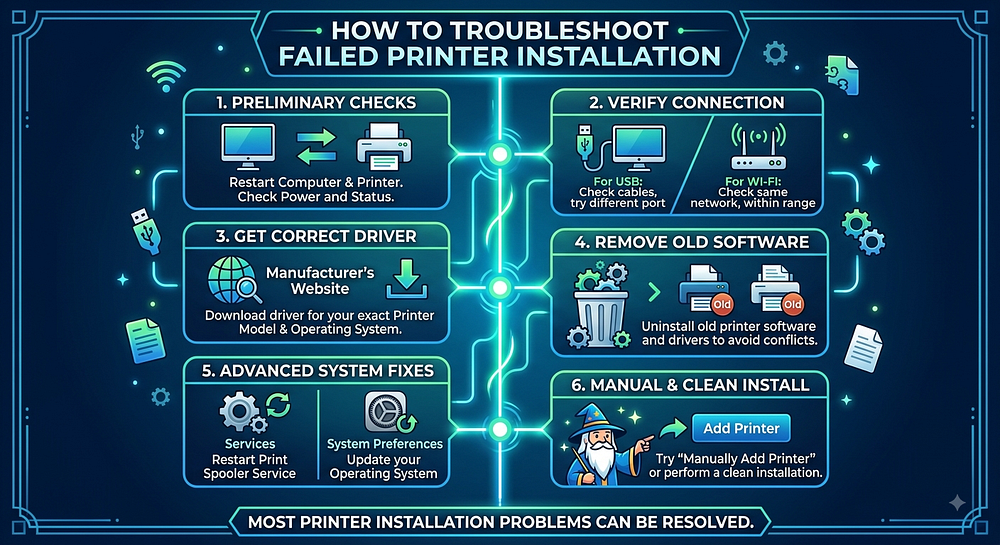
A failed printer installation can usually be resolved by checking the connection, restarting the printer and computer, installing the correct driver, updating the operating system, removing conflicting printer software, and restarting the Print Spooler service.
If automatic installation does not work, manually adding the printer or performing a clean installation may provide a solution. Persistent software conflicts can also be investigated using a clean boot.
The most important step is to use the correct driver for the exact printer model and operating system. Maintaining updated software, reliable connections, and a clean printer configuration can also help prevent future installation failures.


Comments
Post a Comment